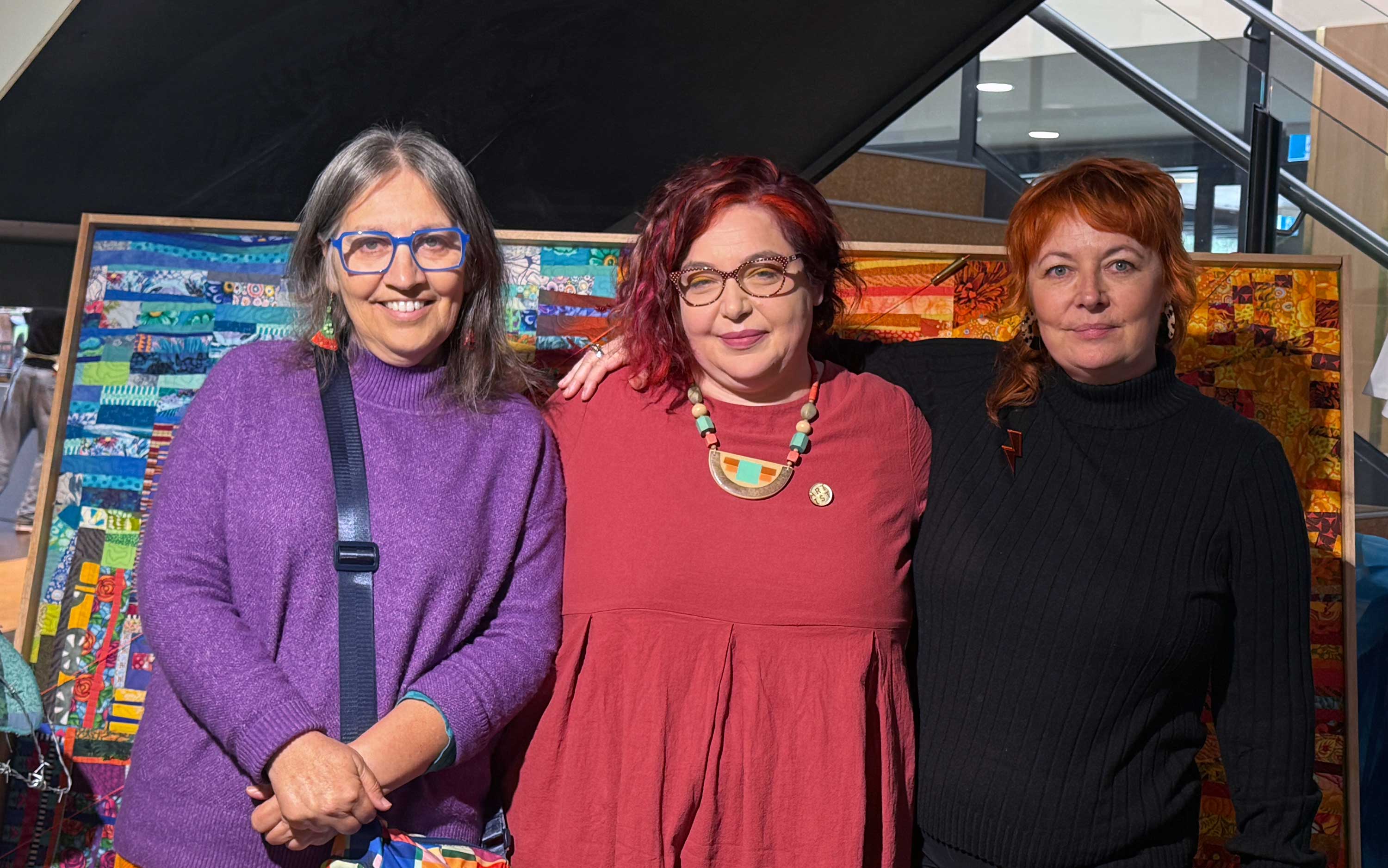
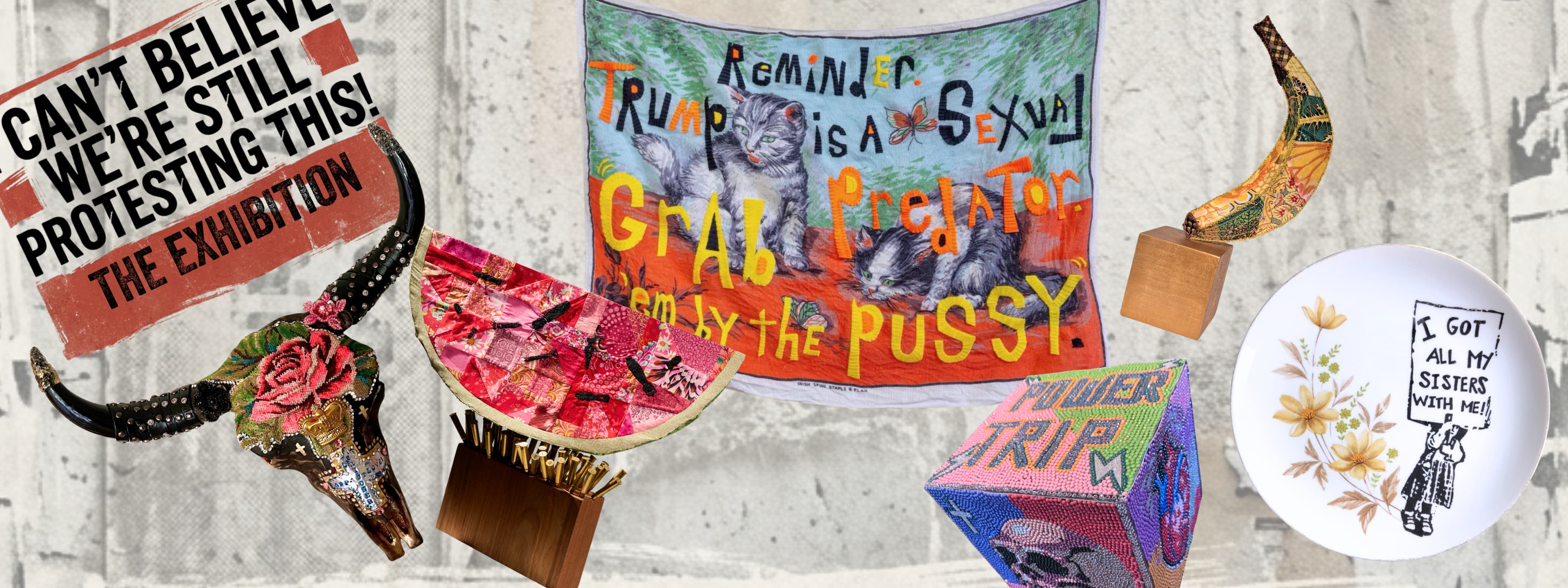
On Saturday 1 August, Burrinja’s Lyre Gallery opens I Can’t Believe We’re Still Protesting This! — a group exhibition bringing together art, activism and social commentary through works by Natasja van Wyk, Nicole Kemp, Kelly Sullivan, Empire of Stuff and anonymous contributors.
The exhibition reflects on issues including women’s rights, political accountability, media representation and the impact of ongoing global conflicts. Through textiles, collage, painting, sculpture, crockery and found materials, the artists respond to a world where many long-standing issues continue to demand attention.
We spoke with Natasja, Nicole and Kelly about the ideas behind the exhibition, their creative processes and the role art can play in encouraging conversation and change.
The title I Can’t Believe We’re Still Protesting This! captures a shared feeling among the artists - frustration that many social issues remain unresolved, but also a determination to keep speaking out.
Natasja van Wyk describes the exhibition as a response to the exhaustion that comes from witnessing the same injustices repeat over time.
“Compassion fatigue is real,” she says. “But so is the danger of letting that fatigue turn into silence.”
For Nicole Kemp, whose political artworks have previously faced challenges within exhibition settings, creating work that addresses difficult subjects is an important part of her practice.
Rather than stepping away from challenging conversations, the artists continue to use their work as a way to question, reflect and encourage dialogue.
Kelly Sullivan’s creative process often begins with ideas in a sketchbook. “You sit with something long enough, and eventually you have to make it,” she explains.
The exhibition brings together a range of perspectives on feminism, pacifism, media language, political systems and social justice. While the themes are broad, the artists see connections between them, particularly the way power structures influence whose voices are heard and whose experiences are valued.
One of Natasja’s featured works, Seeds of Destruction, is a textile piece reflecting on the resilience of the Palestinian people and the watermelon as a symbol of cultural identity and resistance.
The detailed work demonstrates the ability of textiles to communicate complex stories through material, pattern and symbolism.
Empire of Stuff uses crockery and domestic objects to create works that challenge traditional ideas around value and consumption. By placing familiar household materials alongside political messages, the works encourage viewers to reconsider the objects around them.
Kelly Sullivan is a multidisciplinary artist, celebrated for her vibrant, thought-provoking works that merge mixed media, vintage imagery and explorations of women’s and societal issues. Her bold use of colour, texture and mixed media creates visually striking pieces that invite viewers to reflect on themes of identity, empowerment and resilience.
Nicole Kemp’s textile works challenge traditional associations between craft, femininity and domestic labour, using materials often overlooked within contemporary art to comment on social and political issues.
One of the most compelling threads running through this exhibition is the deliberate use of domestic materials, textiles, crockery, tea towels, and found objects like onion netting. You’ll also see more unusual detritus such as spent bullet casings.
For Natasja, working with materials traditionally associated with domestic spaces is an intentional choice. Textile art has historically been undervalued and often dismissed as craft rather than fine art.
By bringing these materials into a gallery setting and combining them with political themes, the artists challenge those assumptions.
"When you make something political out of something domestic, you're saying: these spaces are connected," Natasja explains. "What happens in the world happens in the home. What women make with their hands has always carried meaning; it just hasn't always been taken seriously."
The exhibition highlights how ordinary materials can carry personal histories, cultural meaning and powerful messages.
While the exhibition addresses difficult topics, it is not only focused on frustration. The artists also want to encourage reflection, participation and hope.
Kelly Sullivan's contribution includes an interactive postcard element, inviting visitors to engage directly with the themes, add their voices to the conversation, and write a postcard to themselves about what change they would like to see, personally or globally - which Kelly will send to them in 12 months’ time as a reminder and time for reflection. It transforms passive viewing into active participation.
"I want people to mail themselves a postcard into the future," Kelly says. "Even a small statement, so I can send it back to them. The act of putting words on postcards and reflecting on what mattered to you a year ago and what changes have taken place in a year’s time.”
The activity transforms the exhibition from something visitors simply observe into something they can actively participate in.
The artists hope the exhibition will engage a broad audience, including people who may not already share the same perspectives.
“It would be easy to make work that preaches to the converted,” Natasja says. “But that’s not what we’re trying to do.”
Instead, the exhibition aims to create opportunities for curiosity and conversation. Visitors may connect with a particular artwork, material or story, even if they approach the themes from different viewpoints.
The exhibition is designed as an invitation to look, think and reflect.
Scroll past something online and it's gone. Walk past something on a gallery wall and it stays with you.
This is one of the core arguments for physical exhibition-making in 2026: presence changes everything. When you stand in front of a textile or a sculpture, you cannot simply tap past it. When you hold a postcard in your hands, you are implicated in what it says.
Social media compresses and flattens. A gallery expands. The works in I Can't Believe We're Still Protesting This! are designed to be encountered in person, to take up space, to demand attention, to sit with you on the way home.
As one of the artists puts it: "Discomfort is the first step to evolution." The exhibition does not shy away from making visitors uncomfortable. But it holds them gently while it does so.
Supporting challenging and thought-provoking work has always been part of Burrinja’s history.
The centre was established through community activism when local artists campaigned to retain the former Shire of Sherbrooke building as a community arts centre. Their efforts helped create the cultural organisation that exists today.
I Can’t Believe We’re Still Protesting This! continues that tradition by creating space for conversations around important issues.
The exhibition has been developed with care, ensuring difficult subjects can be approached thoughtfully. It is not intended to overwhelm visitors, but to provide an opportunity for reflection and discussion.
Everyone is welcome, regardless of their background, knowledge of art or familiarity with the topics explored.
I Can’t Believe We’re Still Protesting This! opens at Burrinja’s Lyre Gallery on Saturday 1 August and runs until 6 September 2026.
Entry is free and all are welcome.
Whether you visit with curiosity, questions or a desire to engage with new perspectives, the exhibition offers an opportunity to connect with art that reflects the world around us.
Exhibition Details
Dates: Saturday 1 August – Sunday 6 September 2026
Location: Lyre Gallery, Burrinja Cultural Centre, Upwey
Entry: Free
Gallery Hours: 10am–4pm, Wednesday–Sunday
This article is based on interviews conducted by CJ Baxter (Community Visual Arts Producer, Burrinja Cultural Centre) and Olive Kouris (Work Experience Student, Monbulk College)
Main Image, left to right - Nicole Kemp, Natasja van Wyn and Kelly Sullivan
Burrinja

14 Apr 26
Step into the world of abstract expressionism with artist MaryLin Litchfield as she discusses grief, healing, and her…

23 Mar 26
Discover how Stephen Glover won the 2026 Swinburne Visual Arts Innovation Award with his deeply emotional and boundary-breaking work, "Dear Shadow."